


Lemma 1
The algorithm guarantees mutual exclusion.
Proof.Let processes p and q be two arbitrary processes which share a resource. Assume that p and q were in their critical section at the same time.
In order to gain access to their critical section processes p and q send request messages to all their neighbours. In particular they send request messages to each other. Let tp denote the local clock time when process p sends its request messages and let tq denote the local clock time when process q sends its request messages. Due to the lexical order of time either tp<tq or tp>tq is valid.
If tp<tq is valid then p
would delay replying the
request message of process q until
p finished accessing its critical section, this implies that tp>tq
is valid. However, if tp>tq is valid
q would delay replying the request message of p until
q finished with accessing its critical section, thus leading to
a contradiction that both processes were at the same time in the critical
section. 
Lemma 2
The algorithm guarantees progress.
Proof.Assume there is a point in the execution in which some
processes are hungry, and after this point no process can enter its critical
section. Then the system will reach a state where no messages are sent
any longer and no process changes its state. Let p be a process
in hungry state with the smallest request time. All neighbours in
thinking state must have answered the request messages of
p with sending fork messages. As p is the process
that sent its request messages with the smallest time tuple, also
all processes in hungry state will send fork messages to
p. Thus p will receive fork messages from all its
neighbours and will change its state to hungry. This is a contradiction
to the assumption that no progress happens.
Lemma 3
Every process is able to access its critical section.
Proof.Receiving a request message makes the local clock
of a process at least one unit greater than the time stamp of the request
message. Therefore, a process which sends request messages to all
its neighbours will loose at most one competition with each neighbour whilst
it tries to access a resource. Assume some processes never manage to enter
their critical section, then there must exist for these processes at least
one neighbour which requested the shared resource before, and also cannot
enter its critical section. Let 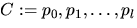 be the longest chain of neighbouring processes (pi, pi+1)
such that all those processes never manage to enter their critical section
and pi+1 prevents pi from
using its resource. Each process pi requested the resources
from its neighbours at local clock time ti. Thus
be the longest chain of neighbouring processes (pi, pi+1)
such that all those processes never manage to enter their critical section
and pi+1 prevents pi from
using its resource. Each process pi requested the resources
from its neighbours at local clock time ti. Thus 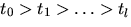 must hold. All neighbours of pl which requested earlier
for their resource will succeed with entering their critical section since
they are not part of C. Therefore, pl will be
able to enter its critical section because it will receive a fork
message from all neighbours which sent their request messages earlier.
Receiving all fork messages from neighbours that sent their messages
later than pl is guaranteed by the algorithm. This leads
to a contradiction due to the assumption that pl never
manages to enter its critical section.
must hold. All neighbours of pl which requested earlier
for their resource will succeed with entering their critical section since
they are not part of C. Therefore, pl will be
able to enter its critical section because it will receive a fork
message from all neighbours which sent their request messages earlier.
Receiving all fork messages from neighbours that sent their messages
later than pl is guaranteed by the algorithm. This leads
to a contradiction due to the assumption that pl never
manages to enter its critical section.